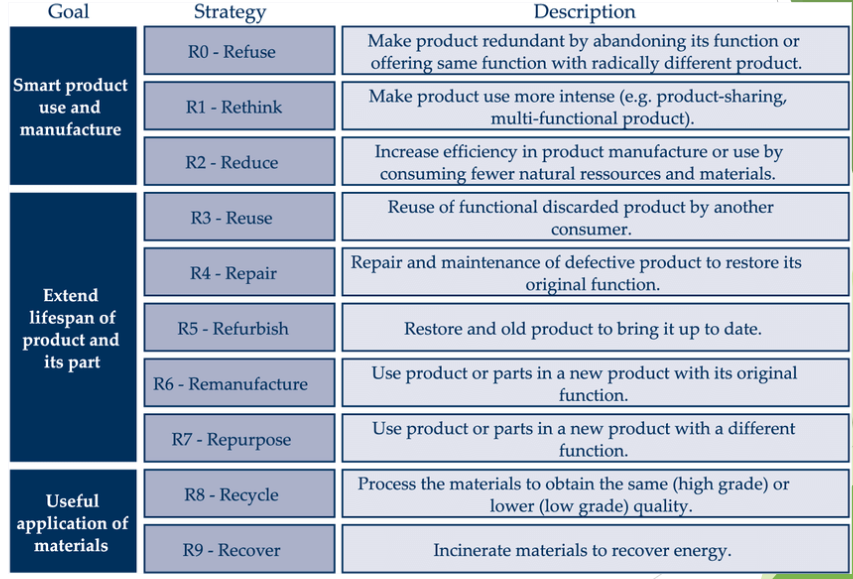
The 10 “R” strategies guide circular thinking.
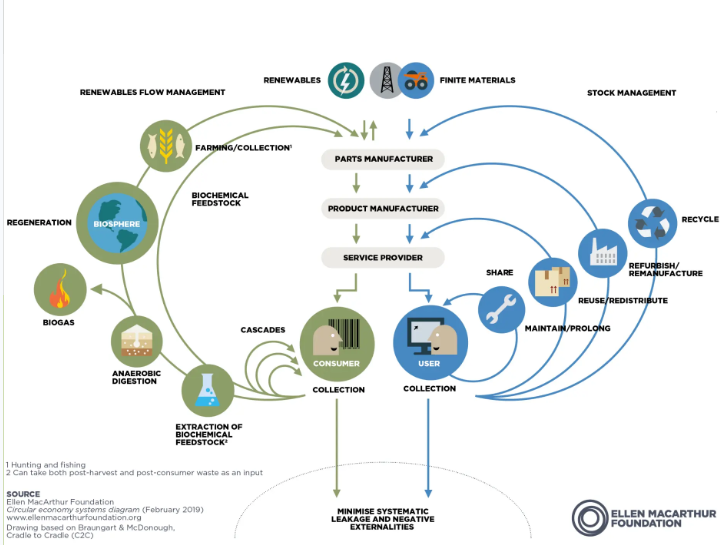
- These 10 Rs represent practical actions to minimise resource use, extend product life, and close the loop
- Intended to help organisations prioritise actions to increase circularity performance
- Brings a life cycle perspective to guide the organisation in identifying the most effective strategy
- Different tools, such as ISO Circular Economy standards (ISO 59000 series) provide a strategic framework to support this transition
The 10 R’s of the Circular Economy
A Compass for Sustainable
Transformation
| Goal | Strategy | Description |
| Smart product use and manufacture | R0 – Refuse | Make product redundant by abandoning its function or offering same function with radically different product. |
| R1 – Rethink | Make product use more intense (e.g., product-sharing, multi-functional product). | |
| R2 – Reduce | Increase efficiency in product manufacture or use by consuming fewer natural resources and materials. | |
| Extend lifespan of product and its part | R3 – Reuse | Reuse of functional discarded product by another consumer. |
| R4 – Repair | Repair and maintenance of defective product to restore its original function. | |
| R5 – Refurbish | Restore an old product to bring it up to date. | |
| R6 – Remanufacture | Use product or parts in a new product with its original function. | |
| R7 – Repurpose | Use product or parts in a new product with a different function. | |
| Useful application of materials | R8 – Recycle | Process the materials to obtain the same (high grade) or lower (low grade) quality. |
| R9 – Recover | Incinerate materials to recover energy. |