
- The growing global awareness of environmental effects and an increasing concern for social responsibility have transformed how companies operate.
- In the current landscape, increasing profits and enhancing environmental impact aren’t conflicting goals; they’re actually intertwined strategy pillars.
- Building a robust sustainability strategy with sustainable business models is imperative for all companies today.
Benefits of Sustainability in Business
- Protect your brand and mitigate risks
- Being purpose-driven is a competitive advantage
- There’s a growing market for sustainable goods
- Cooperative action can drive change

Importance of corporate sustainability strategy
- There are many ways to define a sustainable business model (SBM)
- SBMs work to incorporate the principles of and goals for sustainability into their value proposition, value creation & delivery, and value capture activities.
- This means integrating innovative activities and a wide-range of stakeholders, including society and the natural environment, and planning for the long-term viability of the organization along environmental, social and economic lines.
Sustainable business model canvas
- Different ‘sustainability manifestations’ of the business model canvas have emerged

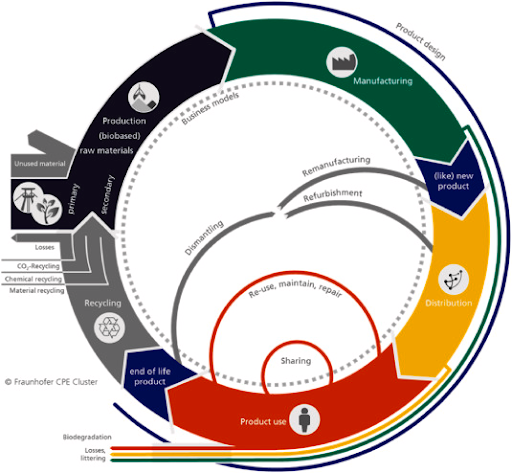
Circular business models
- There is an increasing need for sustainability and circularity in business model development
- The nature of Circular Economy necessitates a comprehensive collaboration across the supply chain, and with it a fundamental rethink of the entire value creation logic.
- Life cycle stages and integrating circularity in business operations
- Business model innovation can be used for transitioning from a linear to circular value creation
Case Study: Practical solutions for circular business models in the fashion industry
Practical solutions for circular business models in the fashion industry
Description: ‘Fast fashion is destroying the planet.’ This point is usually made on news websites like Vox or The New York Times, but also in prestigious academic publishing. The fashion industry uses significant amounts of resources and generates pollution and waste. The fact that clothes are no longer kept and cherished by their owners adds to the fashion industry’s environmental impact, generating large quantities of post-consumer waste. The impact is seen throughout the long value chain of the industry, from the design stage to the disposal of the product.
Circularity is one solution that reduces the impact of fast fashion on the natural environment. The circular economy is a closed-loop system, in which products are used, reused, and transformed into other types of resources. Through circularity, the environment is protected while the company maintains profitability. The circular economy considers the entire product life cycle and all stakeholders in the value chain. It can be defined as ‘an industrial system that is restorative or regenerative by intent and design’.
The circular economy is presented in an antithesis with the linear economy. As such, in the circular economy, the focus is on producing goods that can be reused in the same form or an upcycled/downcycled form, whereas in the linear economy, the goods are sold, used, and become waste. Although the concept of ‘sustainability’ involves all aspects of the triple bottom line (economic, environmental, and social), circular economy research focuses on the environmental dimension. In the fashion industry, the circular design of a business model primarily involves transforming used goods into raw materials for another production cycle. At the same time, resource consumption during the manufacturing process should be reduced to a minimum.
Big players in this sector have created a complex system for reducing their environmental impact while imposing strict rules in their supply chain. At the same time, these companies educate their customers on circularity and promote recycle-or-reuse consumer habits. A comparative perspective on these entities is also provided, regarding how circularity solutions are implemented in the value chain. The proposed circularity model opens new avenues of research and has practical implications for fashion companies and standard-setters.
Main contributions:
- A circular business model implies redesigning strategies, products, and processes.
- Sample companies have proven that they can be engaged in the circular economy, defined as ‘an economic model wherein planning, resourcing, procurement, production, and reprocessing are designed and managed, as both process and output, to maximise ecosystem functioning and human well-being’.
- A complete circularity model is presented theoretically and described through practical examples and solutions that encompass strategies, product development, and process design from the reports of six large retailers. Detailed lists of indicators and circularity targets are linked to each stage of the value chain, emphasizing the importance of quantitative and comparable disclosures. The prominence of circularity solutions in the sample companies’ value chain was investigated from a comparative perspective. Implications for theory, management, and standard-setting were highlighted.

Case Study Questions
For a further analysis of the case study, you may use the following reflection questions:
- Question 1: Explain the role of Product design and its contribution to circular business models in the fashion industry.
- Question 2: Justify how traceability is determinant to circular business models in the sector.
- Question 3: List principles and activities that can positively impact sustainability associated to product manufacturing in the fashion industry.

